| The main Christmas celebrations
in Spain start on 24th December and last until 6th January,
which makes for a long holiday period although many people
do work between the national holiday days which are 25th
December (Navidad), 1st January (Año nuevo) and 6th
January (Epifanía del Señor or Dia de Reyes).
However, in religious terms, the start of the Christmas
season is marked on 8th December with the Feast of the
Immaculate Conception (La inmaculada concepción)
with 6th December also being a national bank holiday.
The 22nd December sees the drawing of
the Christmas lottery (El Gordo) and as tickets are expensive
they are often bought in syndicates. Winning the prize
can and does change lives; often of a whole community
because of the way the tickets are bought in syndicates.
Recent years has seen the rise in popularity of Santa
Claus (Papa Noel) with families but los Reyes continues
to be one of the most popular festivals, especially with
children.
Nativity scenes (Belenes) are a favourite symbol of the
festive season within a home, although Christmas trees
are gaining in popularity. Often families set up the scene
to allow movement of the figures of the three kings Melchor,
Gazpar and Baltasar towards Bethlehem over the Christmas
period, with them arriving at the stable on 6th January.
These intricate models are often works of art and treasured
by their owners and they always include Jesus, Joseph,
Mary and the three kings. There is also a competition
for “Municipal Belenes” often found in convents
and churches, as well as public buildings, around Sanlucar.
Christmas Eve (Nochebuena) is the most
important family meal of the season when families reunite
and share a range of traditional foods; here in Sanlucar
shellfish is important but the cakes such as polvorones
(dust cakes) and turron are also widely eaten washed down
with of course Manzanilla (for the shellfish) and the
sweeter local sherries with desserts.
Christmas Day itself is more low key
than Nochebuena, although it is that day rather than the
24th which is the bank holiday.
28th December - This is the day of Santos
Inocentes (Holy Innocents) and is the same as April Fools'
Day 1st April in the UK, when people, TV stations and
the media play practical jokes on one another.
New
Year's Eve is known as NocheVieja. It is an important
celebration although until midnight people tend to stay
at home eating and drinking. On the stroke of midnight
it is traditional to eat 12 grapes, one on each stroke
of the clock to bring good luck for the New Year accompanied
with some cava of course. Then people venture out onto
the streets and Sanlucar comes alive with a giant party
to celebrate the start of the New Year. |
Sanlucar Los Reyes Magos Three
Kings images loading, please wait.......
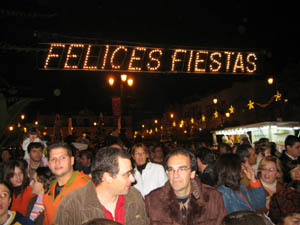
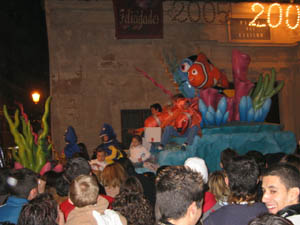
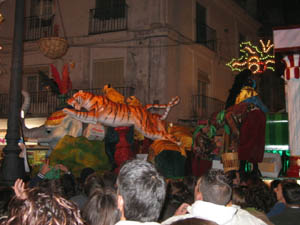
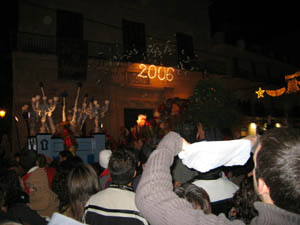
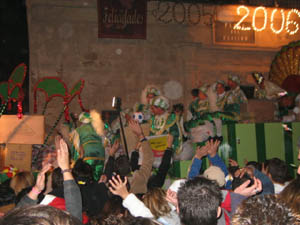
The crowds await
the arrival of the procession in Sanlucar de
Barrameda.
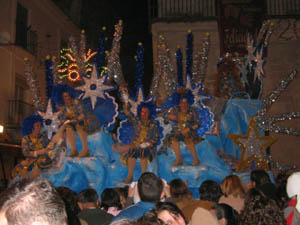
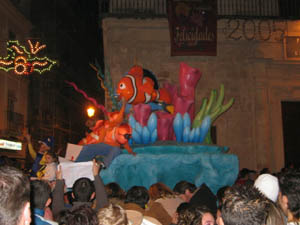
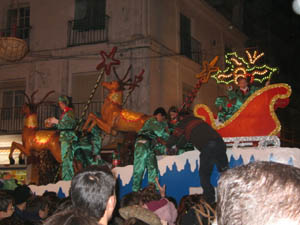
One of the first
floats arrive.
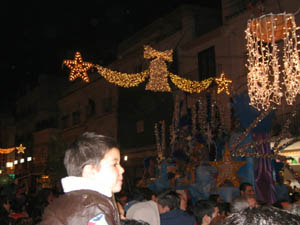
Children on
parents shoulders ready to catch the sweets.
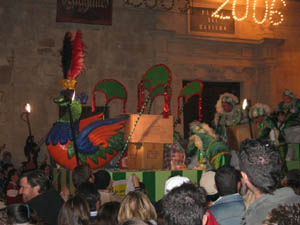
Differently
designed float.
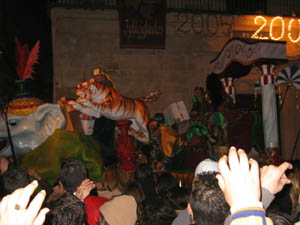
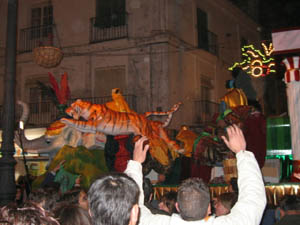
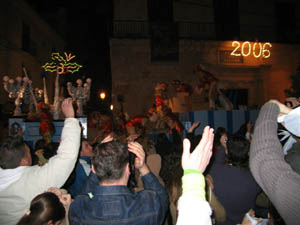
Hands up for
the next sweet!
It's not just
a childrens event.
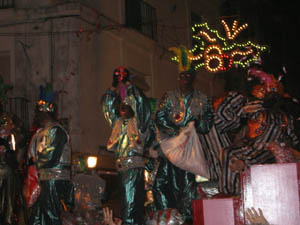
More floats
and more sweets
Gaining an advatage
by catching the sweets in a bag!
More sweets thrown into
the crowd.
Boxes piled
high on the floats.
More goodies
are thrown to the crowds.
Another float
with helpers distributing the sweets.
A bit like Christmas Day, New Year’s Day
is quiet with the younger generation often spending most
of it in bed after the excesses of the previous evening.
On the evening of 5th January (Los Reyos
Magos) the Reyes celebrations begin, which mark the arrival
of the three kings into Bethlehem to pay homage to baby
Jesus. Unless weather does not permit, there is a street
procession (Cabalgata de los Reyes Magos) around the streets
of Sanlucar with lots of weird, wonderful and wacky floats
on which sit the three kings and their helpers, doling out
small presents and handfuls of boiled sweets. It lasts a
couple of hours and is a noisy, colourful and fun occasion
for all ages.
So on the morning of the 6th January the
children awake to discover presents left for them (traditionally
inside their shoes which they leave out) by the passing
three kings. It is a popular day for families to spend time
together, exchange gifts and share a special meal. One food
tradition is the three kings’ cake, el Roscón
de Reyes, which is a sweet bread adorned with dried fruits
and sugar. Inside, bakers have hidden a small prize wrapped
in paper as well as a bean. The person who finds the lucky
prize is supposed to be King or Queen for the day (a gold
paper crown is often provided with the cake) while he who
ends up with the unlucky bean is expected to pay for next
year’s cake.
On the 7th January (or thereabouts) the
children return to school depending of the week what day
of the week it falls on and the seasonal sales commence
– Las Rebajas!
|